In 2012 I won an international prize, given by the IAOS, in applied statistics with the paper Exploratory analysis of the patterns of missing data in the UIS education database ! And this work was published in a peer-reviewed journal ! Very exciting !
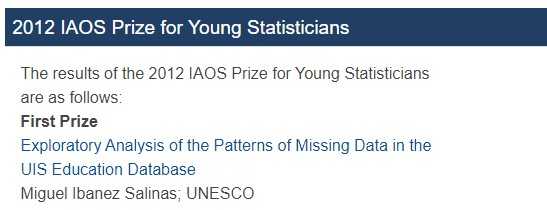
How did this happen? I was working on my graduate thesis in a subject not related to education while also working as a data analyst at UNESCO - Institute for Statistics. Then I changed my thesis’ subject due to two interesting realisations linked to my work with the education database. Part of my functions was to give support to countries to report accurate education data through multiple questionnaires. In my department, every year we would establish a new goal to improve the collection of certain education domain. This can be very effective for the domain in question (ex. finance of primary education), but we did not have a systematic way to monitor the improvements in data collection worldwide. This was the first realisation. For the second one, I assisted to a presentation about the World Bank Worldwide Governance Indicators (Rule of Law, Political Stability, Government Effectiveness, etc.), which, as well as education indicators, are published annually. Then the question came to me: are increases in the production of education statistics correlated to increases in the evaluation of governance indicators?
What is the IAOS? The International Association for Official Statistics (IAOS) is “an international non-governmental organization (NGO), which was created and developed as a specialized section of the International Statistical Institute (ISI)”, which is centered around the “scientific or professional interest in the field of official statistics.” The IAOS organizes every year the IAOS Young Statistician Prize. This international prize is “designed to encourage more young statisticians to take an active interest in official statistics” and “is awarded for the best paper in the field of official statistics written by a young statistician”. UNESCO’s work fits entirely in the definition of official statistics.
What is the paper about? In summary, I looked into the collection instruments (questionnaires) and postulated that there should be some latent dimensions that allow countries to complete and report certains parts independently of others (strong inspiration from psycometrics). At this point, I would treat any missing (not reported) datapoint as zero and an available datapoint as one. A 5-dimension scale of 45 items (an item is related to an specific datapoint from the questionnaire and the information collected is if the datapoint is available or not) was proposed in order to capture and efficiently manage the variability of responses in the education database. This proposed structure allowed a 5-cluster classification of contries. These structures are robust in time (study included 10 years of data).
The longitudinal study of factor scores also showed that increases in governance, as measured by the World Governance Indicators, are positively linked to increases in production of education statistics. This result illustrates the positive relationship between statistics and governance, which is one of the ultimate goals of statistical production (encouraging evidence-based policies).
Finally, this research (e.g. binary factors analysis, cluster analysis, multinomial random effects logistic regression) won the first place of the 2012 IAOS Young Statistician Prize.
Interesting links:
Paper : Exploratory analysis of the patterns of missing data in the UIS education database